Solo · Sep–Nov 2026
WildLens
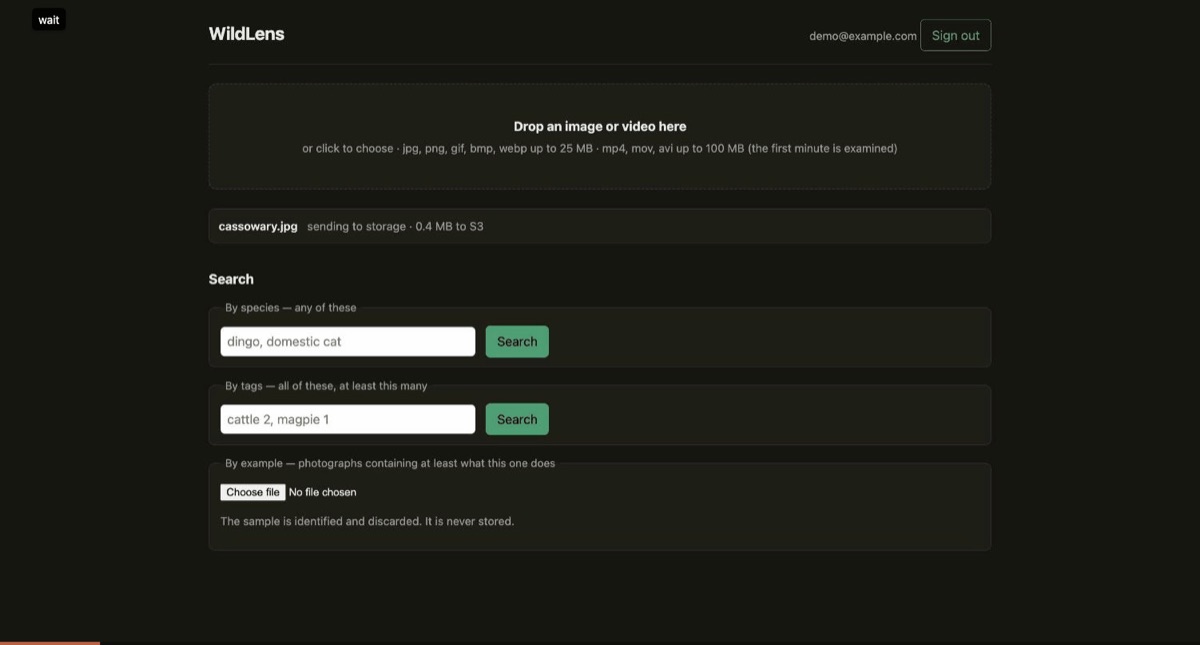
Camera-trap photos and clips, tagged with species by a two-stage ML pipeline and searchable through a secured API.
- ~$4
- worst-case cost, vs ~$80 without the queue
- 100%
- Terraform
- 13
- pipeline stages
- Stack
- AWS, Terraform, Lambda (container), S3, SQS, DynamoDB, Cognito, PyTorch, MegaDetector, GitHub Actions
- Period
- Sep–Nov 2026
The problem
Camera-trap photos and video clips are only useful once someone knows which species are in them. Tagging by hand does not scale, and a naive cloud pipeline can run up a large bill the first time someone uploads a thousand files.
What I built
A serverless platform on AWS, solo. Browsers upload straight to S3 through a presigned URL. S3 events land in SQS rather than invoking Lambda directly, and a container Lambda runs MegaDetector and then a species classifier. Results are tags with counts, such as {"southern cassowary": 1}, searchable by species, by minimum counts, or by example photo through a Cognito-protected REST API. Users can subscribe to email alerts per species.
- Cost-bounded ingest. The queue caps the tagger at two concurrent executions and sends a message to a dead-letter queue after three attempts. A runaway upload burst costs a few dollars instead of about $80.
- Infrastructure as code. Every resource is in Terraform, thirteen modules in one environment, so
terraform destroyremoves the whole estate between sessions. - No long-lived secrets in CI. GitHub Actions lints, tests, builds and validates Terraform without credentials; pull requests that touch infrastructure get a
terraform planthrough a read-only OIDC role. - Operable. Structured logs with a correlation ID, metrics, X-Ray tracing, a dashboard, five kinds of alarm and a runbook organised by symptom.
Architecture
The full ingest path is on an interactive walkthrough: browser, S3, SQS with a dead-letter queue, the container Lambda running both models, and the API behind Cognito.
Results
Cold-start and warm latency were measured before and after one optimisation: caching the loaded MegaDetector model instead of a path to its weights.
| Before | After | Change | |
|---|---|---|---|
| First invocation after deploy | 55.2 s | 42.3 s | −23% |
| Cold start, p50 | 23.6 s | 21.5 s | −9% |
| Warm | 8.35 s | 6.40 s | −23% |
| Peak memory | 3000 MB | 2861 MB | −139 MB |
What I learned
A cache cannot help the invocation that populates it. The change moved a per-request cost to a per-environment one, so warm calls gained a lot and cold starts barely moved. Re-measuring also showed that a mis-read log line had overstated the expected cold-start saving tenfold, so I recorded the correction instead of quietly fixing it.